

The Hidden Cost of Distribution Design Rework
Engineering managers have normalized rework. They shouldn’t have to.
By Brad Irwin, VP of Distribution Design
Most electric utilities running high design volume accept a certain amount of field rework as a normal cost of doing business. A pole location that doesn’t match what the crew found on site. A staking sheet built from GIS data that had already changed by the time it was exported. A design that was accurate when it left the engineering team and arrived at construction carrying errors introduced somewhere in between. These aren’t unusual events; they are recurring ones.
Every engineering manager has a version of this story. The cost gets absorbed; we reschedule crews, expedite materials, delay projects, and back-office reconcile what the design said with what the field found. It’s rarely catastrophic in any single instance. Across a full year of projects, it adds up.
The question worth asking is whether this is actually unavoidable, or whether it’s been normalized because nobody has clearly connected it to a root cause.
This Is a Workflow Problem
Distribution design workflows vary across utilities, but the data integrity challenge is consistent. Design decisions get made in one context — whether that’s a CAD environment, a GIS-native platform, or something in between — and the network record needs to reflect those decisions accurately and quickly. In practice, keeping the two aligned requires manual effort at some point in the process. Data exports, reconciliation steps, or QA cycles are designed to catch discrepancies before they reach the field. That overhead is so common it gets treated as normal. It shouldn’t be.
This is not an indictment of the engineers running these workflows. It’s an indictment of the workflow itself. Competent people working in a system with inherent disconnects will produce inconsistent results. That’s not a performance issue, it’s a system issue.
What Rework Actually Costs
The direct costs of a field discrepancy are visible: crew time, return visits, material changes, schedule impact. These get captured somewhere, usually in project management or operations, rarely attributed back to a design workflow failure.
The indirect costs are harder to see but arguably larger. Engineering time spent on reconciliation instead of design. QA processes built to catch errors that shouldn’t exist. Review cycles extended because no one fully trusts the handoff. Senior engineers pulled into problems that should have been resolved upstream. These costs don’t appear on a single line item. They accumulate invisibly across every project.
A reasonable estimate for utilities running high design volume: if 10 to 15 percent of projects require some form of field correction or design revision tied to data discrepancies, and each incident costs four to eight hours of combined engineering and field time, the annual exposure runs into hundreds of thousands of dollars for a mid-sized utility. That’s before accounting for the regulatory and safety dimensions of working from inaccurate network data.

The Problem Is Getting Harder to Absorb
In the past, utilities have been able to manage this workflow gap because design volume was manageable. The pace of grid modification was steady but not overwhelming. Engineering teams knew their systems, knew where the gaps were, and compensated through experience and informal workarounds.
That’s changing. Distributed energy resource integration, EV load growth, grid hardening programs, and interconnection backlogs are compressing timelines and increasing design volume simultaneously. The same workflow that was manageable at hundreds of projects per year becomes a liability at thousands. The informal knowledge that kept things from falling through the cracks doesn’t scale with headcount. And the tolerance for field errors shrinks as project complexity and regulatory scrutiny increase.
Engineering managers who have absorbed rework as a cost of doing business are increasingly finding that the math no longer works. What was a manageable friction point is becoming a capacity constraint.
What a Better Workflow Looks Like
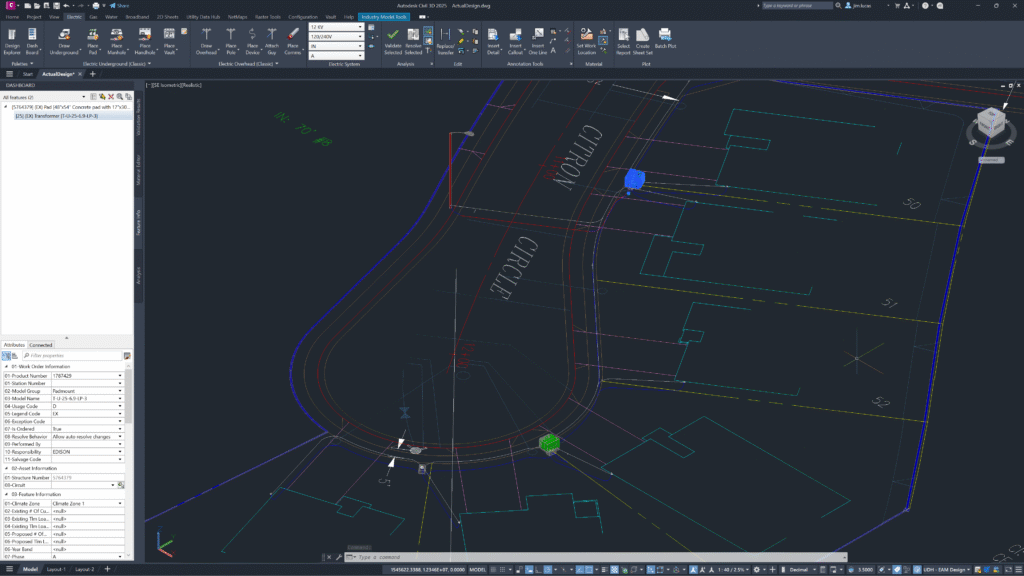
The better model is a design environment that connects natively to GIS and asset management systems — so engineers design in a tool built for engineering, and data flows to GIS and EAM at the right time and in the right state, without manual reconciliation in between.
Utilities that have moved to integrated CAD-GIS design workflows consistently report faster design cycles, reductions in field discrepancies, quicker responses to design changes, and less engineering time spent on reconciliation. The more consequential benefit is what it enables downstream: reliable data that can be trusted for outage management, asset analytics, and capital planning without a separate cleanup effort.
The question for engineering managers evaluating their current workflow is whether the cost of rework and reconciliation they’re absorbing today is worth more than the investment required to eliminate it.
SBS Automated Utility Design (AUD) is a distribution design solution built on AutoCAD or Civil 3D, that integrates design and GIS natively, eliminating the handoff at the center of most design-to-field discrepancies. If you’re evaluating how to reduce rework and improve design accuracy across your organization, contact us to schedule a demo.