
From Concept to BIM: How SBS AI and SubsGPT Transform Substation Design
A Smarter Beginning: Proposal Setup on SBS AI
Early-stage substation planning often requires significant engineering effort before a team can even compare options. SubsGPT, built on the SBS AI platform, changes that by structuring the proposal up front. Users define the project type, configure standard templates, and set guidance parameters that control how conservative or exploratory the AI should be. Before any layouts are generated, SBS AI captures the project intent, key constraints, and engineering expectations and uses them to drive the analysis and the layouts that follow.
Mapping and Site Evaluation in a Unified Environment
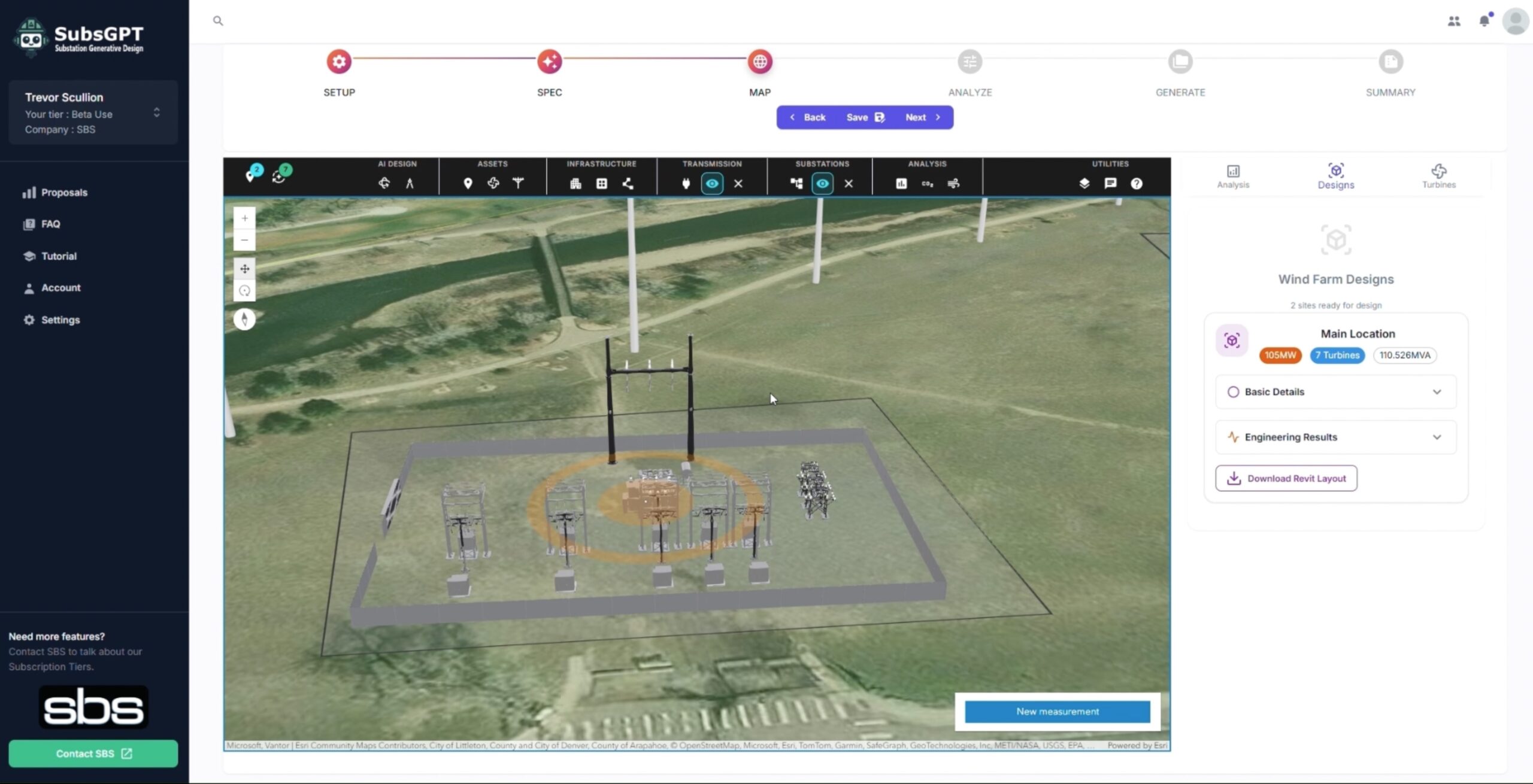
SubsGPT integrates Esri mapping so users can work with real-world data inside the same environment that will generate and evaluate substation layouts. Transmission lines, substations, wind assets, land use, and other ArcGIS layers can be displayed together, eliminating the need to switch between GIS platforms and design software.
When planners sketch potential sites on the map, SBS AI runs a multi-agent analysis in the background. The system evaluates constraints, gathers local data, and returns a scored assessment for each site, allowing teams to compare locations in a meaningful way. Renewable assets such as wind turbines appear as intelligent BIM objects, each carrying metadata that drives the downstream engineering logic and informs substation sizing.
Generative Design with Engineering Insight
Once the inputs are defined, SubsGPT uses its neural network to generate substation layouts inside each site boundary. Guidance settings let users influence the nature of the design, from conservative to exploratory. The system does more than produce a layout; it explains it. Feeder counts, transformer loading, bus ratings, and other critical engineering calculations are tied directly to the concept, giving planners transparency into how the AI arrived at its recommendations. If a layout is not suitable, it can be deleted, adjusted, and regenerated in seconds.
Revit Reconstruction and Detailed Modeling
The workflow hits its stride once a concept layout is approved. SubsGPT outputs a concise layout description that’s automatically rebuilt inside Autodesk Revit. Every transformer, breaker, bay, and structure is placed as an individual Revit element using the organization’s own family libraries. Teams can generate multiple layouts in a single project for true side-by-side comparison, enabling accurate measurement, clash checks, and design evaluation.
Once the model is in Revit, the workflow naturally transitions from concept to detailed design. Teams can continue using standard Revit capabilities, and they can also leverage BIM Substation Designer (when available in Q1 2026) to perform the specialized substation tasks Revit does not handle natively, such as bus and conductor connections, grounding design, clearance checks, and lightning analysis. Together, SubsGPT and BIM Substation Designer form a continuous path from preliminary layout generation to advanced engineering execution.
A Connected Loop from Concept Through BIM
Real projects evolve, and SBS AI is built for iteration. If the site boundary changes, the renewable input grows, or new parameters emerge, users can return to SubsGPT, adjust the inputs, regenerate new layouts, and rebuild updated Revit models. The workflow remains connected from start to finish.
Because SBS AI retains all analysis results, engineering metadata, and design decisions, it can automatically generate proposal documents using the organization’s templates and provide structured content for drawing sets and bills of material in Revit.
The result is a unified, AI-driven workflow that accelerates planning, improves transparency, and maintains continuity all the way into BIM. For utilities, developers, and engineering firms, SBS AI provides a modern approach to substation design: fast, data-driven, and seamlessly integrated from map to model.
If you’re interested in seeing more from SBS AI and SubsGPT, contact us.