Building for the Utility of the Future: AI, Digital Twins, and the Long Game
About This Series
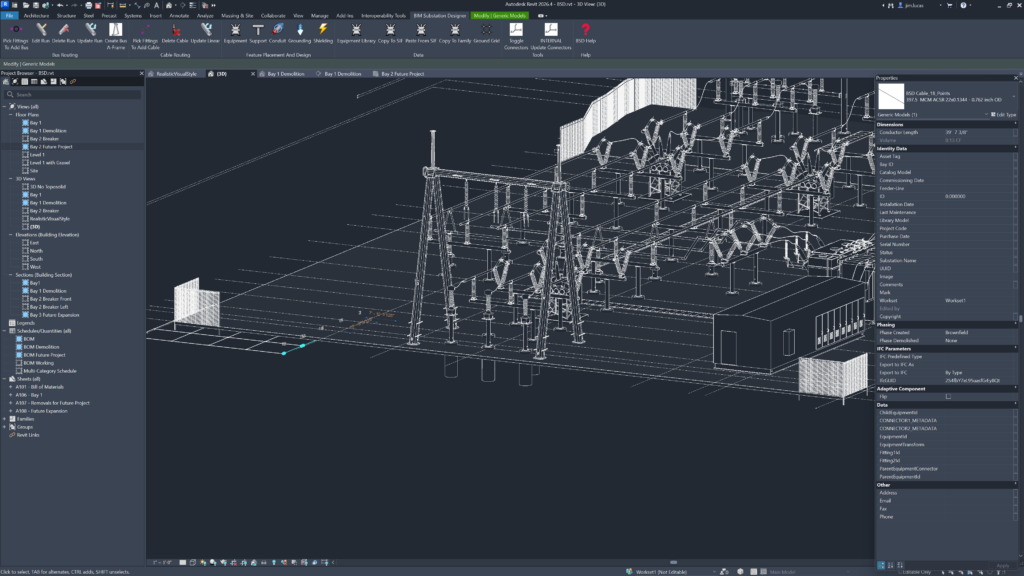
BIM Substation Designer (BSD) is a new kind of substation design tool, but understanding why it matters requires more than a standard product overview. This is the final entry in a three-part series about this new solution, informed by the perspectives of two of the people most responsible for bringing it to life.
Kevin Whyte, SBS Vice President of Substations, and Anthony Contino, SBS Director of Substations, bring an extraordinary depth of experience to the software industry. They have both worked for utilities, managed large-scale projects, and felt the friction that comes from tools that weren’t designed for the problems they’re being asked to solve. That depth of expertise has shaped everything about BSD: why it exists, how it was designed, and where it is headed.
This post builds on the foundation established in Parts 1 and 2. Part 1, “Why We Built BSD on Revit and Why It Was the Right Next Step,” covers the platform story and what BSD delivers on day one. Part 2, “More Than a Design Tool: The Data Problem No One Was Solving,” explores the open data standard at the heart of BSD and why connecting siloed substation data changes what’s possible.
PART 3: Building for the Utility of the Future
Most software gets built to solve an immediate problem. A customer needs a tool for AutoCAD, so you build a tool for AutoCAD. A customer needs something for Revit, so you build for Revit. The market asks, and the vendor responds. For a long time, it’s how the substation design software industry worked.
Kevin Whyte thinks this is the wrong approach. Not just for BSD, but for any software that aspires to serve an industry at a genuine inflection point.
“Our existing tools are still incredibly valuable, but we recognized a real opportunity when we were building BSD,” Whyte said. “We put ourselves in the position of someone running a 10-million customer utility and asked what decisions we would need to make not just today, but 10, 20, 30 years from now.”
That question led Whyte and Anthony Contino somewhere unexpected — away from utilities and toward industries that had already solved problems the utility sector was still treating as unsolvable.
Consider the smartphone. It didn’t emerge because consumers asked for a pocket-sized computer. It emerged because someone looked at where technology was heading and built toward that destination, then showed people what they hadn’t known to ask for. Most utilities today run on systems that have been reliable for years, if not decades. The most forward-thinking ones are beginning to ask the right questions. But the organizations asking those questions are often large enough that the answers get lost in silos before they reach the people who can take action.
SBS is right-sized and well-positioned for this moment, Whyte argues. The advantage is a unique combination: small enough to be nimble and proactive, experienced enough to know what really matters.
“Many of the forward-thinking utilities having these conversations are struggling to take meaningful action quickly,” Whyte said. “We feel that we have a role to play to help facilitate and accelerate change based on what the modern utility truly needs, not just for the next project, but for the next generation of decisions.”
Addressing the AI Readiness Problem
Conversations about the impact of artificial intelligence (AI) are happening across the utility industry. Digital twins, predictive maintenance, automated anomaly detection, AI-assisted capital planning… the vision is clear, and the appetite is genuine. The gap, in most organizations, is the data.
AI doesn’t work on disorganized information. It can’t surface insights from data that lives in disconnected systems, formatted inconsistently, with no shared vocabulary for what anything means. Before a utility can benefit from AI, it needs clean data that is structured, connected, and semantically meaningful. That is precisely what BSD’s open data standard is designed to produce.
“If you want to get into AI and digital twins, you need data structured in a way that’s consumable,” Anthony Contino explained. “You can’t just throw it in a database. It has to be formatted correctly, with the right semantic meaning, and extensible enough to grow. Most utilities don’t have that yet. BSD starts building it from the first project.”
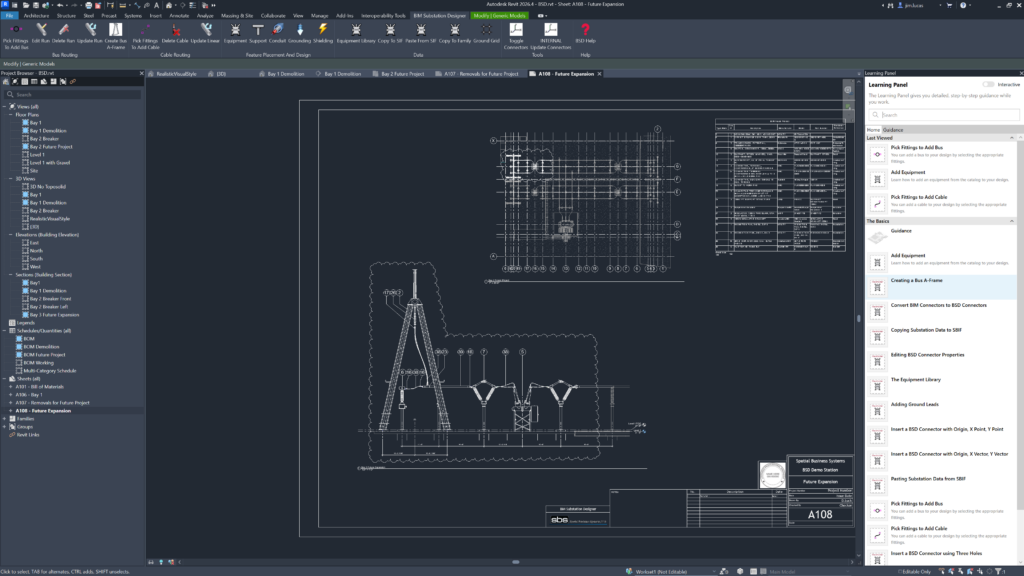
The open data standard underlying BSD is based on IFC and CIM, the international frameworks already used throughout the utility industry. It assigns semantic meaning to every component in a substation model: not just what something is, but what it means, how it relates to other components, and how it aligns with established standards. This is the difference between data that can be searched and data that can drive real insight, the difference between a system that can answer questions and one that can anticipate them.
The SBS AI solution for substation design, SubsGPT, is built on this foundation. Because SubsGPT operates on data structured to the same open standard, it can produce outputs that connect directly to BSD and the rest of the SBS product ecosystem. That means the AI capability and the data infrastructure are designed together, not integrated after the fact.
A Broader Universe of Users
Substations are not built by utilities alone. Data center developers, renewable energy companies, land developers, and engineering firms all design and build substations, often under significantly different time pressures and priorities than those familiar to a traditional utility.
A utility operates on a capital plan that might look a decade ahead. A data center developer operates on a timeline measured in months, sometimes weeks. The efficiency gains BSD delivers are meaningful for both, but the urgency and entry points are different.
For engineering firms and commercial developers, the argument is straightforward: BSD is built on Revit, the platform their broader project teams likely already use. Adding BSD means adding substation-specific intelligence to a tool they already know, without adding a new platform to manage. For firms that win utility contracts by demonstrating delivery speed and design quality, it’s a meaningful procurement advantage.
“There are a dozen or more different groups that go into a substation project, and months and months of work will happen before you even get to the design stage,” Contino said. “All that data is related and relevant. We can start bringing it in and relating it to the substation equipment, then we can build tools for every aspect of a project, not just the design phase.”
The Right Partner for What’s Coming Next
Parts 1 and 2 of this series covered what BSD does today: a faster, more integrated design environment built on the world’s leading BIM platform, with a data architecture designed to connect information that has historically lived in silos. This entry aims to capture something harder to quantify: the intent behind the product, and the thinking that shaped it.
It all starts with the belief that utilities deserve software built by people who understand their problems from the inside. It runs through a commitment to open standards that serve the industry rather than a single vendor. And it lands on a vision of what a truly modern utility looks like: one that makes decisions grounded in data, operates assets with full lifecycle visibility, and uses AI as a powerful present-day tool.
SBS brings a strong combination to this moment: a proven portfolio serving the workflows utilities rely on today, a new platform serving the emerging standards, an open data strategy that connects them, and a team with the depth of experience and forward-looking vision to understand what needs to change.
“This isn’t just about software,” Whyte said. “This is about a programmatic approach to becoming a modern utility that makes decisions in a modern way, using data to justify what you do and why you did it. That’s what this is all about.”
Learn More
For more information about BIM Substation Designer or to schedule a demo, contact us here.